

The Necessity of University Collaboration to Address Societal Challenges
The Necessity of University Collaboration to Address Societal Challenges
The President of the University of Kashan stated that it is essential for universities to interact with one another in order to align and collaborate effectively to resolve societal issues.
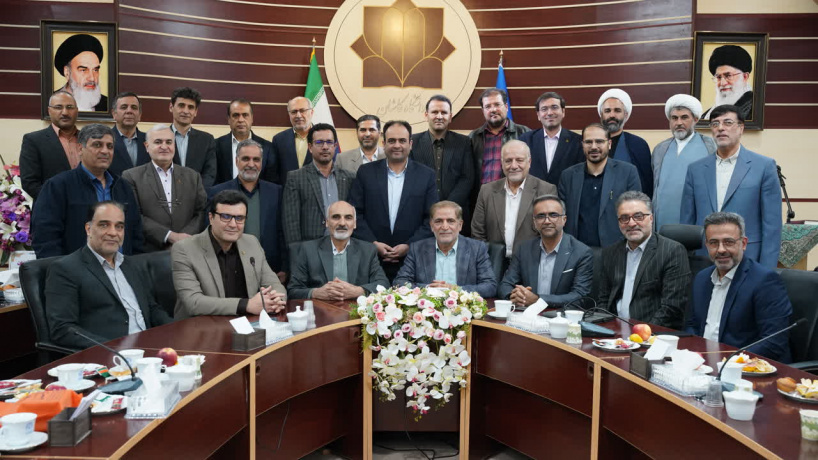
Dr. Behzad Soltani emphasized the importance of holding regular and well-planned sessions to improve interactions between universities and the society during a meeting of the board members of universities in the Kashan region, held on the occasion of the 50th anniversary of the University of Kashan. He added that the primary goal of these meetings is to develop practical and effective solutions that can have a greater impact on the community.
He suggested that these meetings should be held at various intervals, such as monthly, quarterly, or semi-annually, and should address pre-defined topics to enhance productivity.
Dr. Soltani identified smart education, international student programs, language and cultural issues, and emerging technologies such as artificial intelligence as key topics in the educational domain. He noted that future education is expected to be location-independent, necessitating the creation of new and interdisciplinary programs to retain Kashan students locally and strengthen the position of the university nationally and internationally.
The President of the University of Kashan highlighted that in the research domain, challenges such as the lack of comprehensive support for faculty members and the limitation of research activities primarily to publications exist. He emphasized that careful planning is required to improve global rankings for faculty members and to utilize successful experiences in this area.
Dr. Soltani considered the allocation of 10 percent of provincial assets to universities significant and stated that providing this substantial funding to universities can effectively enhance academic facilities.
He emphasized that universities play a critical role in the future of the country and should be regarded as fundamental and essential elements in national development.
The President further underlined the importance of strategic planning and development projects, citing initiatives in nutrition and cost reduction aimed at diversifying student meal options and providing free meals at the University of Kashan, which have resulted in increased satisfaction among students and staff. These experiences could be implemented to improve other universities.
Dr. Soltani also mentioned forward-looking strategies for dormitory construction, public sports policies, and attracting “gray” students (those with average performance) as additional measures to strengthen university interaction. He stressed the necessity of focusing on the position of the university, structural reforms, precise planning, and optimal utilization of resources to enable universities to play an effective role in national development.
He highlighted the importance of the legal status and recognition of universities in Kashan, stating that universities should be visible and acknowledged within society and administrative and decision-making institutions. Dr. Soltani noted that a more comprehensive and provincial perspective regarding the position of the universities is needed so that their role in development and high-level decision-making is not overlooked.
Regarding the current and future role of the university in social responsibility, he remarked that the University of Kashan is still in its early stages and may perform its duties more effectively in five to ten years. Currently, the social responsibility of the university is limited to approximately three percent, which does not fulfill its primary mission.
Dr. Soltani emphasized that, at present, the activities of the university are primarily limited to education, research, and social responsibility. He argued that universities should aim to address urban challenges and city development rather than focusing solely on governmental or institutional issues.
He identified entrepreneurship as another key mission of universities, adding that if a university can transcend its initial responsibilities and become entrepreneurial and development-oriented, its capabilities alongside education and research will increase.
Dr. Soltani stressed the importance of holding regular bi-monthly meetings between universities and society, aimed at creating a structured, specialized, and educational framework to manage university activities and societal interactions more effectively.
He also referred to the rapid technological advancements, particularly in artificial intelligence, noting that in the future, robots and intelligent systems may surpass humans due to their speed, accuracy, and cost-effectiveness. This raises concerns about the future role of humans and underscores the need for strategic thinking in managing these technologies.
The President of the University of Kashan suggested that bi-monthly meetings should address not only specialized discussions but also community engagement and university development. He urged all participants to collaborate in group tasks and in refining and completing programs.
The President of Kashan University of Medical Sciences highlighted academic independence as a key priority for universities, stating that universities should leverage national advantages, demonstrate their strengths, and fulfill their social responsibilities.
Dr. Koochaki emphasized the role of the university in defining the country’s global standing and advancing the scientific and social development of the population, citing the University of Kashan and the University of Medical Sciences as examples of significant educational institutions.
He underlined the importance of academic activities in fostering student collaboration, mutual learning, and engagement with various domains. Universities are not only centers of education but also spaces for intellectual exchange and personal and collective growth.
Dr. Koochaki stressed the importance of coordination and communication among educational vice presidencies, aiming to strengthen shared initiatives and educational collaborations so that universities can contribute more effectively to the scientific and social development of the country.
During this meeting, the vice presidents of the university also presented their views on enhancing cooperation and addressing societal challenges.

Your Comment :